← All Blogs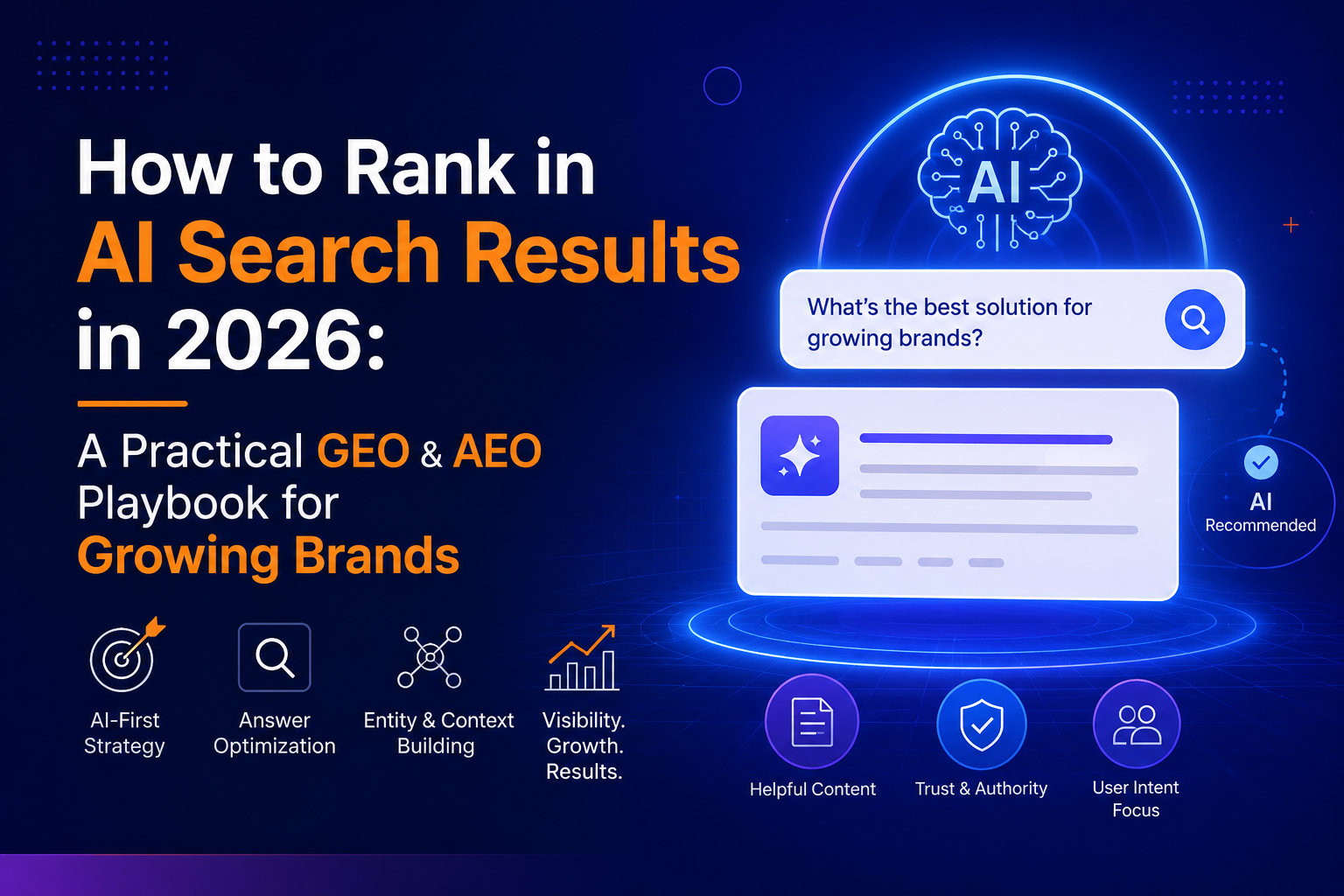
Digital Marketing
How to Rank in AI Search Results in 2026: A Practical GEO & AEO Playbook for Growing Brands
8/19/2026
Quick Answer
GEO/AEO in 2026 means structuring content to answer questions directly in the first 100 words, marking it up with FAQ/Article/Organization schema, strengthening entity signals, and earning citations beyond your own site.
Ranking on Google's page one no longer guarantees visibility. ChatGPT, Perplexity, and Google AI Overviews now answer questions directly, often without a single click to your website. To show up inside those answers, your content needs to be structured for extraction, backed by structured data, and reinforced by citations across the web, not just optimized for keywords.
Why "Ranking" Now Means Two Different Things
For twenty years, ranking meant one thing: land in the top 10 blue links. Today it means two things — SERP ranking (still showing up in traditional search results) and AI visibility / GEO (being the source an AI model cites, quotes, or paraphrases). The second is newer, less understood, and far less competitive — most businesses haven't touched it yet. The good news: content built well for AI extraction tends to perform better in classic SEO too, because both systems reward clarity, structure, authority, and trust.
Step 1: Answer the Question in the First 100 Words
AI models pull the most concise, self-contained answer they can find. Open every page or section with a direct, quotable answer (2–3 sentences), then follow with supporting detail. Avoid "clever" intros that delay the point.
Step 2: Structure Content So Machines Can Parse It
Use one clear H1 and a logical H2/H3 hierarchy with no skipped levels. Break processes into numbered steps, not dense paragraphs. Use tables for comparisons. Keep paragraphs to 2–4 sentences. Add a short definition or summary box near the top of long-form pieces.
Step 3: Mark Up Your Content with Structured Data
Schema markup gives AI systems machine-readable confirmation of what your content is, who wrote it, and how it's organized. Priority schema types: FAQPage (maps Q&A content to how AI retrieves answers), Article/BlogPosting (confirms authorship and dates), HowTo (structures step-based content), Organization + LocalBusiness (reinforces entity identity), and Review/AggregateRating (supports trust signals).
Step 4: Strengthen Your Entity Signals
AI systems try to identify entities — your brand, founders, services — and connect the dots across the web. Reinforce your entity by keeping business name, address, and contact info identical everywhere; publishing a detailed About Us page with real team bios; adding author bylines with expertise context; and getting listed and reviewed on relevant third-party sites.
Step 5: Earn Citations Beyond Your Own Website
LLMs are trained and retrieval-augmented on the broader web, not just your domain. Contribute genuinely useful answers on niche forums and communities, pursue digital PR and guest contributions, encourage detailed customer reviews, and get cited in "best of" and comparison roundups.
Step 6: Keep Freshness Signals Active
AI answer engines lean toward recently updated, verifiably current information. Add a visible "last updated" date and actually update the content. Refresh statistics and examples at least twice a year. Retire or consolidate outdated posts.
Step 7: Monitor Your AI Visibility, Not Just Rankings
Traditional rank trackers won't tell you if ChatGPT is citing you. Manually query ChatGPT, Perplexity, and Google AI Overviews monthly with your core questions, note whether your brand or a competitor gets cited, and track referral traffic from AI sources in GA4.
The Quick-Reference Checklist
Every page opens with a direct, quotable answer. Clear heading hierarchy. FAQ, Article, and Organization schema implemented. NAP and entity details consistent site-wide. Author bios with real expertise. Active off-site presence. Content refreshed and dated regularly. AI citation monitoring in place.
Frequently Asked Questions
Does GEO replace traditional SEO?
No. GEO builds on the same foundation — technical health, authority, and relevance — but adds structure and citation-worthiness specifically for AI retrieval systems.
How long does it take to see AI citations?
Typically 2–4 months for well-structured, newly optimized content, though authoritative existing pages can be picked up faster once schema and structure are corrected.
Do I need to rewrite my entire website?
Not usually. Start with your highest-intent pages — service pages and top-performing blog posts — then expand site-wide.
Can small businesses compete with large brands in AI search?
Yes, often more easily than in traditional SEO. AI models favor clear, specific, well-sourced answers over sheer domain authority, which levels the playing field for niche expertise.